This time the reading is mighty interesting and very sad. Here is a long summary:
It all started with a boy named Simon. He went missing when he was “not quite two and a half” (Hsia) years old. His Christians parents, asked the Bishop Johannes Hinderbach
for help when Simon’s father and his friends could not find the little boy
after searching the city premises. There were already rumors of Jews kidnapping
and killing Christian children during the “holy feast days” and thus the Jewish
homes were searched by the podestà but the child was not seen. The next day
however, little Simon was found dead in the ditch, leading to the house of a
Jew family in Trent.
Simon’s alleged murder occurred during the Passover of 1475
in Trent. In 1475, that week was considered a “holy feast days” by both
Christians and Jews because Passover and Easter were happening a few days after
one another. Such timing was significant because, in the eyes of the Christians
and Magistrates, the death of Simon nicely coincides with Passover, the Jewish
celebration. Thus, it was not very long before the authorities linked the two
together, by accusing the Jews of performing a ritual murder on Simon, during
the mentioned Jewish celebration.
 |
| A picture of St. Simon of Trent. Or what Hiderbach claimed to have happened to him during Passover. |
The unfortunate Jews who were involved in the upcoming
tragedy could be categorized into 3 households. Samuel’s household, with ten
adults and one child, Tobias’s household, with six adults and four children and
finally, Engel’s household, with six adults and three children. Members of
households are families, friends and acquaintances who happened to lodge in
that household during Passover.
After the discovery of the body, all of the men were
arrested while the women and children were placed under house arrest. The men
were separated and then interrogated with torture, at different times. The
magistrates’ coercion method was simple. The magistrates ignored everything
that they didn’t want to hear and just keep questioning and torturing the Jews
until they said what the magistrates wanted to hear. Before long everyone more
or less ‘confess’ to have participated in the alleged ritual murder of Simon.
After the men, the magistrates turn towards the Jewish women
who were under house arrest. At this point in time, many of the Jewish men had
tried to protect their families, especially the women and children, by telling
the magistrates that the women did not participate in the actual murder of the
boy and that the younger children were ignorant of this ‘ritual’. However, that
did not stop the magistrates from interrogating them. The women were questioned
and if their answers were not consistent with the “truth” that the men had
said, the women would be tortured.
However, women were always perceived as the weaker sex and
the magistrates could not treat them as harshly as the Jewish males. For
example, in November of 1475, the “trial” for the Jewish women had to be postponed
because the magistrates received heavy criticism by the authorities in Rome who
disapprove with the idea of torturing a woman. The women were also asked if
they were pregnant, because the magistrates were not allowed to torture
pregnant women. The women also received less punishment as they turned “the
gender separation in worship to their advantage, the women represented
themselves primarily in their domestic roles as only partial participants in
religious rites…” (Hsia) such as the
blood libel. In the end, thanks to these attributes, women were “under less
pressure to conform to the image of the demonic Jew” (Hsia). The women
were still tortured but none was executed.
Out of the 22 Jewish adults, 16 were executed at different times,
with different methods of execution. The head of the three households; Samuel,
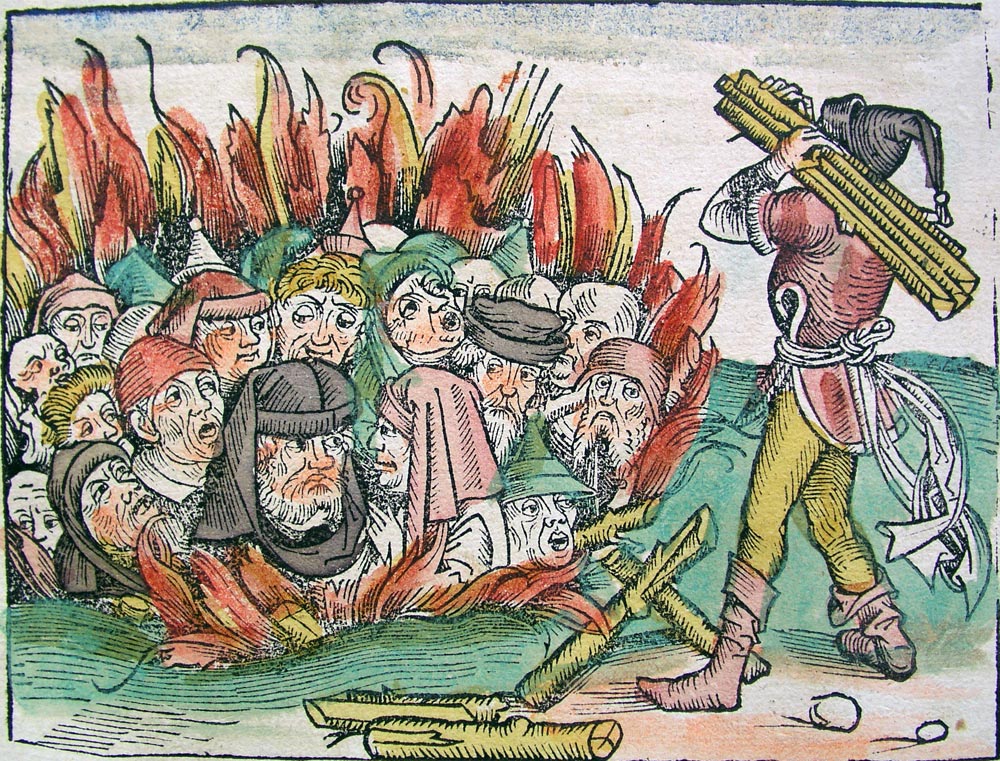
Tobias, Engel, with 3 more Jewish men, were tied to the stake and burned alive.
For the rest of the Jew men, 2 committed suicides in prison, 2 were hanged at
the gallows, and another 2 were broken at the wheel and then burned. The last 4
asked for baptism before death and they received a more ‘humane’ execution
method, where 2 of them were beheaded while the other 2 were hanged. Only men were executed.
 |
| The Gallows |
 |
| Burning of Jews |
 |
| The Wheel |
There were many political forces behind this incident and most
of them revolve around the prince-bishop Hinderbach. He was the one turned
Simon into the “Blessed Simon Martyr” and promoted Simon’s cult to the
Christians. Under Hinderbach’s encouragement, the story of Simon’s “martyrdom”
spread through poems, hymns, sermons and more. Next, the “Book of miracles of
the Blessed Simon Martyr of Trent” was published with 129 miracles attributed
to Simon and soon enough, pilgrimages to Trent started making Simon’s cult
became well known.
Ultimately, Hinderbach probably needed Simon’s cult to
thrive so that he could justify his persecution of Jews to the pope, the doges
and other Roman authorities. Many other power plays, involving powerful leaders
of countries and other powerful authoritative figures, ensued before and even
long after these executions had been carried out. And to think that all of this
was caused by a single Christian toddler who died during Passover of 1475.
Works Cited
Hsia, R.
Po-Chia. Trent 1475; Stories Of A Ritual Murder Trial . New
Haven: Yale University Press, 1992.
PS: I do not own any of these pictures. Got them from:
Burning of Jews— http://skepticism-images.s3-website-us-east-1.amazonaws.com/images/jreviews/Burning-Jews.jpg


No comments:
Post a Comment